What it costs to own a home in Madison, WI
The median homeowner with a mortgage in Madison, WI spends about $2,048 a month to keep the house, of which property taxes are about $5,798 a year. That is the full cost of owning, not just the loan payment. It includes the mortgage, property taxes, insurance, utilities and any HOA fees. It decides whether staying is affordable, and it is the number people underestimate when they buy.
US Census Bureau, American Community Survey 5-year estimates averaging 2019 to 2023. They show the usual cost of owning here, not this month.
- Monthly, with a mortgage
- $2,048
- Monthly, mortgage paid off
- $826
- Property taxes
- $5,798/yr
- Spending over 30% of income
- 21.9%
All in: loan, taxes, insurance, utilities
What ownership costs with no loan at all
Median for the metro
Of 120,209 mortgaged households
How many people here are stretched
About 21.9% of Madison homeowners with a mortgage spend more than 30% of their household income on housing. HUD and the Census Bureau call a household cost burdened once housing takes more than 30% of income. That is where housing starts crowding out everything else. Roughly 120,209 households here carry a mortgage. That is a fairly low share, so most owners here have room in the budget. If you are the exception, the local averages do not describe your situation. Do not let them talk you out of acting on it.
Across the 100 largest metros we track, that is the 23rd lowest share of stretched homeowners. Property tax is an unusually large part of that. About 24% of what a Madison owner pays in a year goes to the tax bill, so a higher assessment hits harder here than in most places. Nearby, Milwaukee at $1,831 and Grand Rapids at $1,534 are cheaper to hold each month, while Chicago at $2,179 and Minneapolis at $2,069 are pricier.
On the other half of the picture, houses in Madison take about 35 days on average to go under contract. So even where a normal sale is the right answer, it is not a quick fix for a monthly cost problem.
The house with no mortgage on it
Owners in Madison who have paid off the mortgage still spend about $826 a month, compared with $2,048 for owners still paying one. That money goes to taxes, insurance, utilities and upkeep, and it does not stop when the loan does. So an inherited house with no mortgage can still cost more than the family can afford to keep. "There is no mortgage" is not the same as "there is no hurry".
Madison reassesses every year, so the bill tracks the market
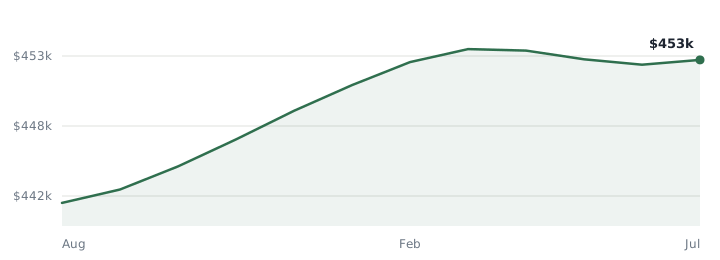
The Madison City Assessor values all property in the city every year at 100 percent of market value as of January 1. In its 2025 report, the average single-family assessment in the city rose 5.2 percent, from $457,300 to $481,300.
If you think your number is wrong, you have to move fast. In 2026, assessment notices went out May 1. The Open Book period to fix record errors ran May 4 to May 8. Objections to the Board of Assessors were due by 4:30 p.m. on May 15.
After that, the Board of Review is the last city level of appeal.
Sources: City of Madison Assessor: The 2025 property tax base of the City of Madison; City of Madison Assessor: Open Book and assessment appeals.
What the city, the schools and state credits add up to in Madison
A Madison bill carries levies for Dane County, Madison College, the City of Madison and the Madison Metropolitan School District.
A city explainer on the 2025 bills puts the city's own rate at 0.007003. That is about $7 per $1,000 of assessed value. On the average $481,300 home, it comes to roughly $3,371 before credits and special assessments.
The school line moved the most. The same explainer quotes the district saying its 2025-26 levy would rise about 20 percent. That adds about 96 cents per $1,000 of value. Meanwhile the state school levy credit fell from 1.8718 mills to 1.7285 mills. For the average home, that credit went from $855.97 to $831.93.
The lottery and gaming credit is another state credit, but you have to claim it. The Wisconsin Department of Revenue says it applies to a home you own and live in as your main home on January 1 of the tax year. For 2025-26, the average credit across the state was $190.
You can pay Madison taxes in full by January 31. Or you can pay in four installments, due January 31, March 31, May 31 and July 31.
Sources: City of Madison, District 10: Let's Talk Budget, 2026 property taxes; Wisconsin Department of Revenue: Lottery and gaming credit FAQs; Wisconsin Department of Revenue: Lottery and gaming tax credit report, 2025; City of Madison Finance: Property taxes.
Street projects and pipes that land on a Madison owner
When the city rebuilds or resurfaces a street, part of the cost can come back to you. Madison Engineering says these special assessments are liens on the property. They are based mainly on how much street frontage you have.
They are usually paid back over 8 years, or 15 on some higher-cost projects, with a yearly installment on the tax bill. The city also notes that selling often means paying assessments in full, including early (preliminary) ones. If the final amount comes in lower, you get a refund.
Madison Water Utility says it has worked since 2000 to replace all known lead service lines, more than 8,000 of them. Lead lines still turn up now and then, usually when a property changes hands. Owners may qualify for a rebate that covers half the replacement cost, up to $3,000.
Sources: City of Madison Engineering: Assessments and payment plans; City of Madison Finance: Special assessments; Madison Water Utility: Lead and copper in water.
The costs of selling a house in Madison
Wisconsin charges a real estate transfer fee of $0.30 for each $100 of value, which is $3 per $1,000. The Department of Revenue says the counties keep 20 percent and the state keeps 80 percent. The return must be filed online before the deed is recorded.
Most sellers must also give the buyer a Real Estate Condition Report within 10 days after a contract is accepted (Wis. Stat. Chapter 709). If the buyer does not get it on time, the buyer may back out within 2 business days after that period.
Personal representatives, trustees, conservators and court-supervised fiduciaries who never lived in the home are exempt. So are transfers that are exempt from the transfer fee. A real estate attorney can tell you whether an exemption fits your sale.
Sources: Wisconsin Department of Revenue: Real estate transfer fee report, 2025; Wisconsin Statutes, Chapter 709: Disclosures by owners of real estate.
Local facts checked September 2026. Rates and rules change; a real estate attorney or the office named above can confirm them for your property.
If keeping it no longer works
For what a normal sale would involve here, see how long it takes to sell a house in Madison. For the market as it stands this month, see our Madison page.
Common questions
- How much does it cost to own a home in Madison?
- About $2,048 a month for the median owner with a mortgage. That covers the loan, property taxes, insurance, utilities and any HOA fees. Owners who have paid off the mortgage still spend about $826 a month on everything else. Census figures averaging 2019 to 2023.
- How much are property taxes in Madison?
- The median household pays about $5,798 a year. That is a median for the whole metro, so a pricier house pays more. A reassessment after a sale or an improvement can also move it sharply. Your own bill is the one that matters, and it is public record.
- How often does Madison reassess my home?
- Every year. The City Assessor values all property each year at 100 percent of market value as of January 1. Objections are due by May 15.
- What is the transfer fee when I sell a house in Madison?
- Wisconsin's real estate transfer fee is $0.30 per $100 of value, or $3 per $1,000. On a $400,000 sale, that comes to $1,200.
- Will I owe street assessments if I sell my Madison house?
- Madison Engineering says a sale often requires any unpaid special assessments to be paid in full, including preliminary ones. If you pay a preliminary assessment and the final one is lower, the city sends a refund.
Source: U.S. Census Bureau, American Community Survey 5-year estimates, 2019-2023. Tables B25088, B25091 and B25103. Figures are metro-wide medians and describe no individual property.
Tell us what you need for your Madison house
You do not need a number ready, or photos, or a plan. Want to know your real options, even the ones that do not involve us? Call and ask.

Sabrina usually picks up. (615) 576-8827