We buy houses in Chicago, IL
We buy houses in Chicago, IL for cash, in any condition. You pay no agent commissions and make no repairs before you sell. We buy with our own money, so we can commit to a closing date. Market figures below cover August 2026 and were last refreshed on September 17, 2026.
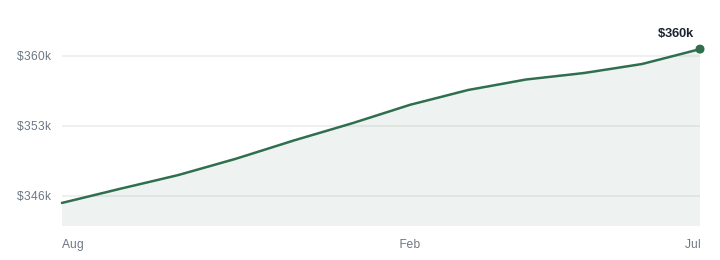
The typical home in Chicago, IL is worth around $357,000, below the national typical value of $369,000. That value is up about 4.9% over the past year. It is a market-wide figure. A house that needs major work sits well below it, and a renovated one sits above.
The Chicago market right now
- Typical home value
- $357,000
- Days to go under contract
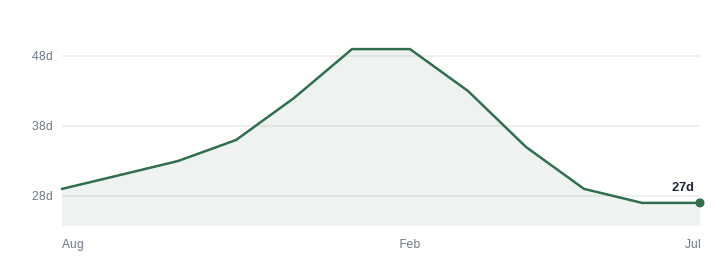
- 29 days
- Listings cutting their price
- 25.4%
- Compared to nationally
- 3% lower
- Homes for sale
- 24,419
- New listings a month
- 9,838
- Months of supply
- 2.5
- Sales closing below asking
- 37.1%
+4.9% over the past year
About the same as a year ago
-1.2% vs. a year ago
National typical value is $369,000
+1% vs. a year ago
+2% vs. a year ago
Tight market, limited buyer choice
Nationally 50.0%
Chicago, IL housing figures for August 2026, except the share closing below asking, which Zillow publishes a month behind and covers July 2026. Last refreshed September 17, 2026. Source: Zillow Research. Months of supply is calculated here as for-sale inventory divided by the monthly sales count. These are market-wide figures, not a valuation of any individual property.
What the Chicago numbers mean for your sale
Houses here go under contract in about 29 days on average. That is quick, since the national figure is closer to 53 days. At this pace, a house in good shape with a sensible price usually sells the normal way without much trouble. So if your house shows well and you have no deadline, listing it in Chicago will likely net you more than a cash sale. We would rather tell you that than talk you out of it.
About 25.4% of listings in Chicago have cut their asking price, close to the national share of 26.4%. That is a normal amount of repricing. Neither buyers nor sellers have a clear edge right now.
When selling for cash still makes sense in a fast market
Chicago moves quickly enough that a house in good shape does not need us. We are still the better answer when the house cannot be shown well. That means major repairs you will not pay for, a tenant in place, an inherited house full of belongings, or a probate timeline. It also means a deadline that a 30-to-60-day mortgage approval cannot meet. Speed and certainty are what we sell. In a market this quick, only buy them if you really need them.
How the sale runs, from first call to closing, is on how it works. The side-by-side with listing through an agent, including the row where listing wins, is on cash offer vs realtor.
Three transfer taxes on one Chicago deed
A sale inside Chicago can carry three transfer taxes: one for the state, one for the county and one for the city. Each is charged per $500 of the price, and any part of $500 counts as a full step.
The rates are:
- State of Illinois: 50 cents per $500 (35 ILCS 200/31-10)
- Cook County: 25 cents per $500 (55 ILCS 5/5-1031)
- City of Chicago: $5.25 per $500 in total.
The city splits its tax in two. The Department of Finance says the buyer generally pays the $3.75 city portion. You, the seller, generally pay the $1.50 portion that helps fund the CTA.
Chicago Title's transfer tax chart, dated July 1, 2026, lists the seller as the party mainly liable for the state and county taxes too.
On a $300,000 sale, our own math puts the seller's share at about $1,350. That is $300 for the state, $150 for the county and $900 for the CTA portion.
Sources: City of Chicago Department of Finance: Real Property Transfer Tax (7551); Illinois General Assembly: 35 ILCS 200/31-10, state real estate transfer tax; Illinois General Assembly: 55 ILCS 5/5-1031, county real estate transfer tax; Chicago Title: Transfer Taxes, Chicago Metropolitan Area, as of July 1, 2026.
The water bill certificate the city stamps depend on
Before your deed can get Chicago's transfer stamps, you need a Full Payment Certificate from the Department of Finance. It shows that the water and other utility charges on the account are paid. Without it, the city stamps needed to record the deed cannot be bought.
The city requires the certificate even when a sale is exempt from its transfer tax. The fee is $50, and it is waived for an exempt sale marked on the form. Any open balance on the account has to be paid first.
You can apply online, or in person at City Hall, 121 N. La Salle St., Room 107. The buyer, the seller or the closing attorney can apply. Some in-person requests finish the same day. Others need a field review or a final meter reading.
If someone else drops off the form for you, the city says to allow up to 10 business days.
Skipping it has a cost. If a certificate was required and not obtained, the city holds both seller and buyer liable for unpaid utility charges, penalties and fees.
Sources: City of Chicago Department of Finance: Full Payment Certificates.
Who values, bills and records a Chicago house
Cook County splits property tax work across several offices. The Assessor's office lays it out this way:
- the Assessor sets market values
- the Board of Review finalizes them after appeals
- the County Clerk works out tax rates
- the Treasurer sends the bills and collects the tax.
The Assessor reassesses one third of the county each year, so each area comes up every three years. It rotates between the north suburbs, the south suburbs and the City of Chicago.
Bills come in two parts. For tax year 2025, the Treasurer lists the first part as due April 1, 2026. The second part was due October 1, 2026. Check both on the Treasurer's site before you sign a contract.
Deeds are recorded by the Cook County Clerk's Office at 118 N. Clark Street. State law has the county transfer tax collected before a deed is recorded (55 ILCS 5/5-1031).
Sources: Cook County Assessor's Office: The Cook County Property Tax System; Cook County Treasurer's Office: Pay Online with Your Bank Account (due dates); Cook County Clerk's Office: Recordings.
Selling a Chicago house that came through an estate
Cook County estates go through the Probate Division of the Circuit Court. The judges sit on the 18th floor of the Richard J. Daley Center. The Clerk's probate office is on the 12th floor, in Room 1202.
The court clerk has a form called the Notice of Probate and Release of Estate's Interest in Real Estate. An independent representative uses it to release the estate's claim on a house. It also names the heirs or legatees who took title at the death (755 ILCS 5/20-24(a)).
The form says it must be recorded in each county where the estate owns real estate. A probate attorney can confirm what your estate needs before a sale.
Sources: Circuit Court of Cook County: Probate Division; Clerk of the Circuit Court of Cook County: Notice of Probate and Release of Estate's Interest in Real Estate (CCP 0421).
Local facts checked October 2026. Rates and rules change; a real estate attorney or the office named above can confirm them for your property.
Markets near Chicago
We buy across this whole region, including the towns between these metros.
- Toledo, OH211 mi
- Des Moines, IA309 mi
- Omaha, NE432 mi
- Chattanooga, TN489 mi
- Rochester, NY517 mi
- Little Rock, AR554 mi
Counties in Illinois with their own page: Coles County.
Selling a house in Chicago
- Who pays the Chicago transfer tax when I sell my house?
- Both sides pay part of it. The city's total is $5.25 per $500 of the price. The Department of Finance says the buyer generally pays $3.75 and the seller generally pays the $1.50 CTA portion. The state and county add 75 cents per $500, which Chicago Title's July 2026 chart lists as the seller's.
- Do I need a water certificate to sell a house in Chicago?
- Yes, in nearly every sale. The city needs a Full Payment Certificate showing the utility account is paid before it sells the transfer stamps. The fee is $50, waived for exempt sales. You can apply online or at City Hall, Room 107.
- Where is my Chicago deed recorded?
- With the Cook County Clerk's Office at 118 N. Clark Street. The county transfer tax is collected before the deed is recorded (55 ILCS 5/5-1031). The city stamps must be on the deed first, which needs the water Full Payment Certificate.
Tell us what you need for your Chicago house
Two minutes to ask, no obligation, and no fee whatever you decide. If we are not the right answer, we will say so.

Sabrina usually picks up. (615) 576-8827