We buy houses in Omaha, NE
We buy houses in Omaha, NE for cash, in any condition. You pay no agent commissions and make no repairs before you sell. We buy with our own money, so we can commit to a closing date. Market figures below cover August 2026 and were last refreshed on September 17, 2026.
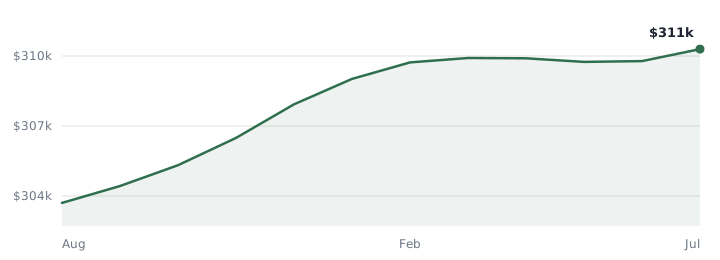
The typical home in Omaha, NE is worth around $308,000, below the national typical value of $369,000. That value is up about 2.5% over the past year. It is a market-wide figure. A house that needs major work sits well below it, and a renovated one sits above.
The Omaha market right now
- Typical home value
- $308,000
- Days to go under contract
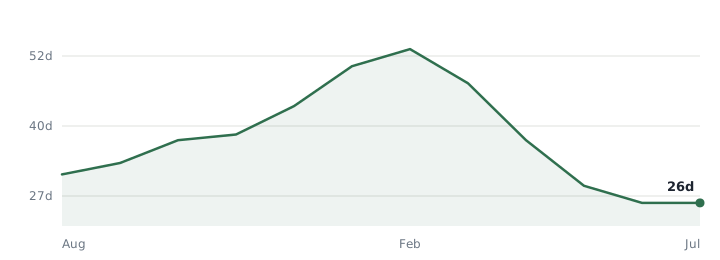
- 29 days
- Listings cutting their price
- 30.2%
- Compared to nationally
- 16% lower
- Homes for sale
- 2,919
- New listings a month
- 1,219
- Months of supply
- 2.8
- Sales closing below asking
- 38.9%
+2.5% over the past year
-7% vs. a year ago
+0.3% vs. a year ago
National typical value is $369,000
-3% vs. a year ago
-5% vs. a year ago
Tight market, limited buyer choice
Nationally 50.0%
Omaha, NE housing figures for August 2026, except the share closing below asking, which Zillow publishes a month behind and covers July 2026. Last refreshed September 17, 2026. Source: Zillow Research. Months of supply is calculated here as for-sale inventory divided by the monthly sales count. These are market-wide figures, not a valuation of any individual property.
What the Omaha numbers mean for your sale
Houses here go under contract in about 29 days on average. That is quick, since the national figure is closer to 53 days. At this pace, a house in good shape with a sensible price usually sells the normal way without much trouble. So if your house shows well and you have no deadline, listing it in Omaha will likely net you more than a cash sale. We would rather tell you that than talk you out of it.
About 30.2% of listings in Omaha have cut their asking price, above the national share of 26.4%. Lots of price cuts usually means sellers start above what buyers will pay, then chase the market down. If you list, the real risk is not that the house never sells. It is spending two or three months learning your first price was too high, while the costs keep running.
If timing is your main question, see how long it takes to sell a house in Omaha. It goes stage by stage, including what a normal sale adds after the house goes under contract.
If the real question is whether you can afford to keep it, see what it costs to own a home in Omaha. That includes what owners with no mortgage left still pay.
When selling for cash still makes sense in a fast market
Omaha moves quickly enough that a house in good shape does not need us. We are still the better answer when the house cannot be shown well. That means major repairs you will not pay for, a tenant in place, an inherited house full of belongings, or a probate timeline. It also means a deadline that a 30-to-60-day mortgage approval cannot meet. Speed and certainty are what we sell. In a market this quick, only buy them if you really need them.
How the sale runs, from first call to closing, is on how it works. The side-by-side with listing through an agent, including the row where listing wins, is on cash offer vs realtor.
Nebraska raised its deed stamp tax on Omaha sales in July 2026
If you sold an Omaha house a few years ago, the stamp tax on this sale will be higher. The tax falls on the grantor, which is you as the seller (Neb. Rev. Stat. 76-901). The Douglas County Register of Deeds collects it when the deed is recorded.
The Nebraska Department of Revenue lists the rate history. It was $2.25 per $1,000 of value from July 2005 through September 2, 2025. Then it was $2.32 until July 17, 2026. Since July 18, 2026, it has been $3.32 per $1,000.
The law sets the rate back to $2.32 for transfers on or after January 1, 2032.
By our own math, a $250,000 sale now carries $830 in stamp tax. A year earlier, at the old rate, it was $580.
Value here means the full consideration paid, including any lien the buyer takes over. A deed is assumed to be taxable unless an exemption is shown on its face or proven to the register (section 76-902).
The buyer has a filing of their own. The buyer must file a completed Real Estate Transfer Statement, Form 521, when the deed is presented (section 76-214). The register of deeds will not record the deed without it. The statement then goes to the county assessor.
Sources: Nebraska Legislature: Neb. Rev. Stat. 76-901, Tax on grantor; rate; Nebraska Department of Revenue: Documentary Stamp Tax Rate History; Nebraska Department of Revenue: Documentary Stamp Tax; Nebraska Legislature: Neb. Rev. Stat. 76-214, Real estate transfer statement.
What Nebraska's condition disclosure asks of an Omaha seller
Every seller of a one to four unit home in Nebraska must give the buyer a signed, written statement of the property's condition (section 76-2,120).
It covers:
- included appliances
- the electrical, heating, cooling, water and sewer systems
- known defects that materially affect value
- environmental hazards.
It also covers:
- easements and encroachments
- utility connections
- carbon monoxide alarm compliance.
You fill it out to the best of your knowledge, and you may mark an item as unknown. It must reach the buyer on or before the date the purchase contract becomes binding. The buyer signs to confirm getting it.
If you skip it, the sale is not void. But the buyer can sue for actual damages, court costs and attorney's fees within one year.
The law does not cover court ordered and foreclosure sales. It also leaves out transfers by a fiduciary settling an estate or trust, unless the fiduciary lived in the home. Sales between co-owners or to a spouse, parent or child are left out too.
A real estate attorney can confirm whether one of these fits your sale.
Sources: Nebraska Legislature: Neb. Rev. Stat. 76-2,120, Written disclosure statement.
Douglas County tax calendar and prorations
The Douglas County Treasurer mails tax statements each December, and all taxes are due by December 31.
Douglas County has more than 100,000 people. Because of that, the first half is late on April 1 and the second half on August 1 (section 77-204). That is a month earlier than in smaller Nebraska counties. The Treasurer notes that overdue balances build interest at 14 percent a year.
Whatever month you close, check your closing statement. Look at which half-year payments are made, which are still open, and how the year is split with the buyer. Questions about the assessed value go to the Douglas County Assessor, not the Treasurer.
Sources: Douglas County Treasurer: Real Property Tax; Nebraska Legislature: Neb. Rev. Stat. 77-204, Real estate taxes; when delinquent.
Selling an inherited Omaha house and the county inheritance tax
Nebraska still has an inheritance tax, and it is paid to the county. For deaths on or after January 1, 2023, close relatives pay 1 percent of the clear market value each person receives above $100,000 (section 77-2004). That covers a parent, grandparent, sibling, child or other lineal descendant.
Property passing to a surviving spouse is not taxed. Neither is a share passing to one of those relatives who is under 22.
The Douglas County Treasurer takes these payments at 1819 Farnam Street, Room H02. You need a signed court order or a worksheet signed by the County Attorney.
The Treasurer notes the tax must be paid within 12 months of the death to avoid penalties and stop interest (section 77-2010). A tentative payment can be made first with county court approval. A probate attorney can tell you how the tax is figured for your family.
Sources: Nebraska Legislature: Neb. Rev. Stat. 77-2004, Inheritance tax rate for immediate relatives; Douglas County Treasurer: Inheritance Tax.
Local facts checked September 2026. Rates and rules change; a real estate attorney or the office named above can confirm them for your property.
Markets near Omaha
We buy across this whole region, including the towns between these metros.
Selling a house in Omaha
- How much is the documentary stamp tax on an Omaha home sale?
- Since July 18, 2026, Nebraska charges $3.32 per $1,000 of value. The seller pays it when the deed is recorded. By our math, that is $830 on a $250,000 sale. State law drops the rate to $2.32 on January 1, 2032.
- Do I have to fill out a disclosure statement to sell my Omaha house?
- Usually yes. Sellers of one to four unit homes must give one before the purchase contract binds the buyer (section 76-2,120). Estate fiduciaries who never lived in the home, foreclosure sales and some family transfers are exempt.
- Is there inheritance tax on a house I inherited in Douglas County?
- Possibly. For deaths since January 1, 2023, close relatives pay 1 percent on what each receives above $100,000. Spouses pay nothing. It is paid to the Douglas County Treasurer, and paying within 12 months of the death avoids penalties.
Tell us what you need for your Omaha house
Two minutes to ask, no obligation, and no fee whatever you decide. If we are not the right answer, we will say so.

Sabrina usually picks up. (615) 576-8827