We buy houses in New Haven, CT
We buy houses in New Haven, CT for cash, in any condition. You pay no agent commissions and make no repairs before you sell. We buy with our own money, so we can commit to a closing date. Market figures below cover August 2026 and were last refreshed on September 17, 2026.
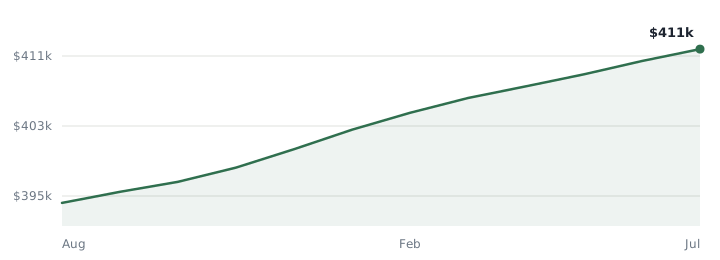
The typical home in New Haven, CT is worth around $409,000, above the national typical value of $369,000. That value is up about 4.9% over the past year. It is a market-wide figure. A house that needs major work sits well below it, and a renovated one sits above.
The New Haven market right now
- Typical home value
- $409,000
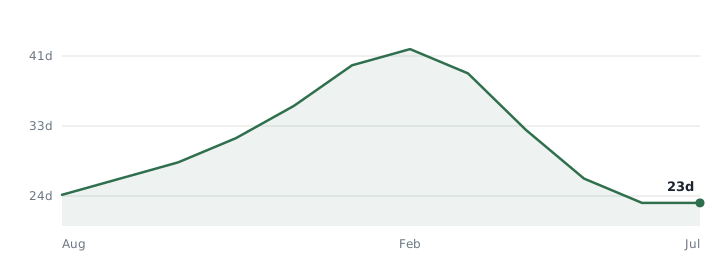
- Days to go under contract
- 25 days
- Listings cutting their price
- 23.0%
- Compared to nationally
- 11% higher
- Homes for sale
- 1,979
- New listings a month
- 847
- Months of supply
- 2.5
- Sales closing below asking
- 28.7%
+4.9% over the past year
+4% vs. a year ago
+2.2% vs. a year ago
National typical value is $369,000
+11% vs. a year ago
+7% vs. a year ago
Tight market, limited buyer choice
Nationally 50.0%
New Haven, CT housing figures for August 2026, except the share closing below asking, which Zillow publishes a month behind and covers July 2026. Last refreshed September 17, 2026. Source: Zillow Research. Months of supply is calculated here as for-sale inventory divided by the monthly sales count. These are market-wide figures, not a valuation of any individual property.
What the New Haven numbers mean for your sale
Houses here go under contract in about 25 days on average. That is quick, since the national figure is closer to 53 days. At this pace, a house in good shape with a sensible price usually sells the normal way without much trouble. So if your house shows well and you have no deadline, listing it in New Haven will likely net you more than a cash sale. We would rather tell you that than talk you out of it.
About 23.0% of listings in New Haven have cut their asking price, below the national share of 26.4%. Few price cuts suggests sellers here price close to what the market will pay, and get it. That is a fair setting for listing a house in good shape.
If timing is your main question, see how long it takes to sell a house in New Haven. It goes stage by stage, including what a normal sale adds after the house goes under contract.
If the real question is whether you can afford to keep it, see what it costs to own a home in New Haven. That includes what owners with no mortgage left still pay.
When selling for cash still makes sense in a fast market
New Haven moves quickly enough that a house in good shape does not need us. We are still the better answer when the house cannot be shown well. That means major repairs you will not pay for, a tenant in place, an inherited house full of belongings, or a probate timeline. It also means a deadline that a 30-to-60-day mortgage approval cannot meet. Speed and certainty are what we sell. In a market this quick, only buy them if you really need them.
How the sale runs, from first call to closing, is on how it works. The side-by-side with listing through an agent, including the row where listing wins, is on cash offer vs realtor.
How a New Haven property tax bill is figured
Connecticut law requires every town to assess property at 70% of its present true and actual value. New Haven then applies its mill rate to that assessment.
For fiscal year 2027, which runs July 1, 2026 through June 30, 2027, the state's official data puts New Haven at 39.962 mills. The rate was 39.4 mills in fiscal year 2026 and 38.5 mills in fiscal year 2025.
Here is the math on a house with a true value of $300,000. The assessment would be $210,000. At 39.962 mills, the yearly tax comes to about $8,392.
Your real bill depends on the assessor's figure for your parcel. Pull that number from the city before you weigh any offer, ours included.
Sources: Connecticut General Assembly: General Statutes Chapter 203 (section 12-62a); State of Connecticut Open Data: Mill Rates for FY 2014 to 2027 (Office of Policy and Management).
The paperwork a New Haven buyer will ask for
For a one to four family house in New Haven, state law generally requires a written residential condition report. You hand it over before the buyer signs anything binding. It uses the template set by the Department of Consumer Protection.
The buyer signs a receipt for it. A copy signed by both of you is attached to the purchase agreement.
Selling as-is does not switch this off. If no report is provided, the contract must give the buyer a $500 credit at closing. You also still have to disclose defects you actually know about that seriously hurt the home's value, safety, or useful life.
You do not have to order inspections to fill in the form. Transfers by estate fiduciaries and sales of property taken through foreclosure are exempt.
Sources: Connecticut General Assembly: General Statutes Chapter 392 (sections 20-327b to 20-327e).
Conveyance tax when a New Haven deed is recorded
Connecticut collects its conveyance tax from the seller through the town clerk at recording. For homes, the state rate is:
- 0.75% up to $800,000
- 1.25% on the next slice up to $2.5 million
- 2.25% beyond that.
Every town also gets a base local share of 0.25%. The tax applies when the price is $2,000 or more. The clerk marks the payment on the deed itself.
A Connecticut General Assembly research report names New Haven as one of the targeted investment communities. State law lets those towns charge up to 0.25% more.
So on a $300,000 sale, expect $2,250 to the state and between $750 and $1,500 to the city. Ask the city clerk's office which figure applies on your date.
Sources: Connecticut General Assembly: General Statutes Chapter 223, Real Estate Conveyance Tax (sections 12-494 and 12-495); Connecticut Office of Legislative Research: OLR Backgrounder, Real Estate Conveyance Tax (2010-R-0430).
Selling a New Haven house after a death
Probate in Connecticut is split into 54 districts. The New Haven Probate Court is at 200 Orange Street, 1st floor, according to the Secretary of the State's register. The state's estate tax law points to the probate court for the district where the owner lived.
That law makes estate tax a lien on the real property of the person who died until it is dealt with. The probate court issues a certificate of release of lien once it finds the tax is paid, properly assured, or not owed.
The certificate is recorded with the town clerk as proof the lien is gone. Estate fiduciaries are also exempt from the condition report described above. A real estate attorney can confirm the steps for your estate.
Sources: Connecticut Secretary of the State: Register and Manual, Probate Courts; Connecticut General Assembly: General Statutes Chapter 217, Estate Tax (section 12-398).
Local facts checked September 2026. Rates and rules change; a real estate attorney or the office named above can confirm them for your property.
Markets near New Haven
We buy across this whole region, including the towns between these metros.
Selling a house in New Haven
- What is New Haven's mill rate right now?
- Connecticut's official data lists New Haven at 39.962 mills for fiscal year 2027, which began July 1, 2026. The rate is applied to your assessment. State law sets that at 70% of the property's true value.
- How much conveyance tax does a New Haven seller pay?
- On a home under $800,000, the state takes 0.75% of the price and the city takes a local share of 0.25%. State law allows New Haven up to 0.25% more. The seller pays it to the clerk when the deed is recorded.
- Does an estate selling a New Haven house need a condition report?
- No. Connecticut exempts transfers by executors, administrators, trustees, and conservators from the residential condition report. The estate may still need a certificate of release of the estate tax lien from the probate court. That certificate is recorded with the town clerk.
Tell us what you need for your New Haven house
Two minutes to ask, no obligation, and no fee whatever you decide. If we are not the right answer, we will say so.

Sabrina usually picks up. (615) 576-8827