We buy houses in Durham, NC
We buy houses in Durham, NC for cash, in any condition. You pay no agent commissions and make no repairs before you sell. We buy with our own money, so we can commit to a closing date. Market figures below cover August 2026 and were last refreshed on September 17, 2026.
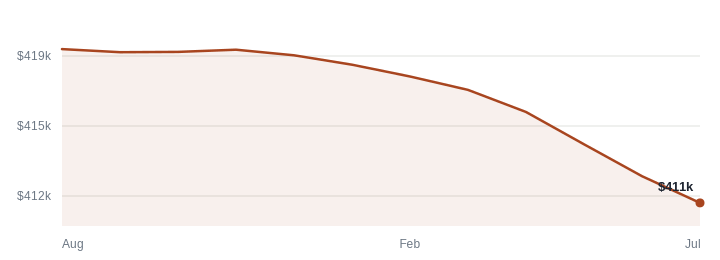
The typical home in Durham, NC is worth around $405,000, above the national typical value of $369,000. That value has fallen about 2.2% over the past year. It is a market-wide figure. A house that needs major work sits well below it, and a renovated one sits above.
The Durham market right now
- Typical home value
- $405,000
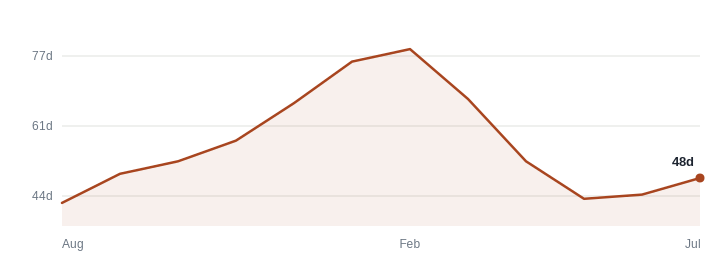
- Days to go under contract
- 54 days
- Listings cutting their price
- 33.1%
- Compared to nationally
- 10% higher
- Homes for sale
- 2,514
- New listings a month
- 688
- Months of supply
- 3.9
- Sales closing below asking
- 58.1%
-2.2% over the past year
+29% vs. a year ago
About the same as a year ago
National typical value is $369,000
+9% vs. a year ago
-0% vs. a year ago
Broadly balanced
Nationally 50.0%
Durham, NC housing figures for August 2026, except the share closing below asking, which Zillow publishes a month behind and covers July 2026. Last refreshed September 17, 2026. Source: Zillow Research. Months of supply is calculated here as for-sale inventory divided by the monthly sales count. These are market-wide figures, not a valuation of any individual property.
What the Durham numbers mean for your sale
Houses here take about 54 days on average to go under contract. That is roughly in line with the national figure of 53 days. Keep in mind that clock stops at contract, not at closing. A buyer with a mortgage then needs another 30 to 60 days to fund. So a normal sale in Durham realistically takes a few months from listing to money in your account.
About 33.1% of listings in Durham have cut their asking price, above the national share of 26.4%. Lots of price cuts usually means sellers start above what buyers will pay, then chase the market down. If you list, the real risk is not that the house never sells. It is spending two or three months learning your first price was too high, while the costs keep running.
How to think about it here
Durham sits close to the national average on both speed and price cuts, so neither route is clearly right. It comes down to your house and your situation. If the house is in good shape and you can wait a few months, listing will usually net more. If it needs real work, has people living in it, or you face a date you cannot move, certainty is worth more than the difference.
How the sale runs, from first call to closing, is on how it works. The side-by-side with listing through an agent, including the row where listing wins, is on cash offer vs realtor.
The deed tax a Durham seller pays
North Carolina charges an excise tax on each deed that sells real estate. The rate is $1 for every $500 of the price, or any part of $500 (G.S. 105-228.30).
The law puts this tax on the transferor, which means the seller. It must be paid to the Register of Deeds before the deed can be recorded (G.S. 105-228.30).
By our own math, a $300,000 sale carries $600 in excise tax.
The Durham County Register of Deeds keeps deeds, deeds of trust and plats. The office is at 201 East Main Street, 2nd Floor, in Durham County Administration Building II. You can call it at 919-560-0480.
Sources: North Carolina General Assembly: G.S. 105-228.30; Durham County: Register of Deeds.
The disclosure form, and when it does not apply
Most North Carolina home sellers must give the buyer a residential property disclosure statement (G.S. 47E-4). For each item, you can report what you know. You can also mark that you make no representations about it.
Timing matters. The form must reach the buyer no later than when they make an offer (G.S. 47E-5). If it comes late, the buyer may cancel. That right ends at the first of these:
- three calendar days after the buyer gets the form
- three calendar days after the contract was made
- closing or move-in.
Some sales do not need the form at all (G.S. 47E-2). A few examples:
- a sale by a fiduciary settling an estate, trust or guardianship
- a sale under a court order or a foreclosure
- a sale from one co-owner to another
- a sale only to a spouse or a direct relative, such as a child.
If you inherited a Durham house and are selling for the estate, a real estate attorney can confirm whether that exemption fits.
Sources: North Carolina General Assembly: G.S. 47E-4; North Carolina General Assembly: G.S. 47E-5; North Carolina General Assembly: G.S. 47E-2.
Durham tax rates for 2026, after the revaluation
Durham County Tax Administration lists, assesses and collects property tax. The county reappraised all real property as of January 1, 2025. After that reset, both the county and the city cut their rates.
For 2026, which is fiscal year 2026-2027, the county lists these rates per $100 of value:
- Durham County: $0.5792
- City of Durham: $0.4371
- Combined inside city limits: $1.0163.
The combined city rate was $1.3949 in 2024, before the revaluation. It was $0.9913 in 2025. By our own math, a house valued at $300,000 inside city limits owes about $3,049 for 2026.
A home outside city limits pays the county rate plus a fire district rate instead. The county lists every district on its tax rates page.
Sources: Durham County: Tax Administration; Durham County: Tax Rates; City of Durham: Proposed FY25-26 Budget Meets Growing Service Delivery Needs.
If your Durham tax bill is behind
The county mailed 2026 bills on August 10, 2026. They were due September 1 and can be paid without interest through January 5, 2027. Partial payments on real property are also allowed without interest until then.
After that, state law adds interest (G.S. 105-360):
- 2 percent from January 6 to February 1
- three-fourths of 1 percent a month after February 1, until paid.
From March 1 to June 30, unpaid real estate accounts must be listed in local newspapers. You pay the cost of that ad (G.S. 105-369). The tax collector can also foreclose on the house, which takes a court order (G.S. 105-375).
If you are behind, call the tax office at 919-560-0300 for a payoff figure before you agree on a price.
Sources: Durham County: Durham County Residents to Receive 2026 Tax Bills Soon (August 4, 2026); North Carolina General Assembly: G.S. 105-360; Durham County: Billing and Collections.
Local facts checked October 2026. Rates and rules change; a real estate attorney or the office named above can confirm them for your property.
Markets near Durham
We buy across this whole region, including the towns between these metros.
Selling a house in Durham
- Who pays the deed tax when I sell my house in Durham?
- The seller does. North Carolina's excise tax is $1 for every $500 of the price, and the law puts it on the transferor. It is paid to the Durham County Register of Deeds before the deed is recorded (G.S. 105-228.30).
- What is the 2026 property tax rate in the City of Durham?
- Durham County lists a 2026 county rate of $0.5792 and a city rate of $0.4371 per $100 of value. Together that is $1.0163 inside city limits. Homes outside the city pay the county rate plus a fire district rate.
- Do I need a disclosure form to sell an inherited house in Durham?
- Maybe not. North Carolina exempts a sale by a fiduciary in the course of settling an estate or trust (G.S. 47E-2). Most other home sales need the form before the buyer makes an offer. A real estate attorney can confirm which rule fits your sale.
Tell us what you need for your Durham house
Two minutes to ask, no obligation, and no fee whatever you decide. If we are not the right answer, we will say so.

Sabrina usually picks up. (615) 576-8827