We buy houses in Augusta, GA
We buy houses in Augusta, GA for cash, in any condition. You pay no agent commissions and make no repairs before you sell. We buy with our own money, so we can commit to a closing date. Market figures below cover August 2026 and were last refreshed on September 17, 2026.
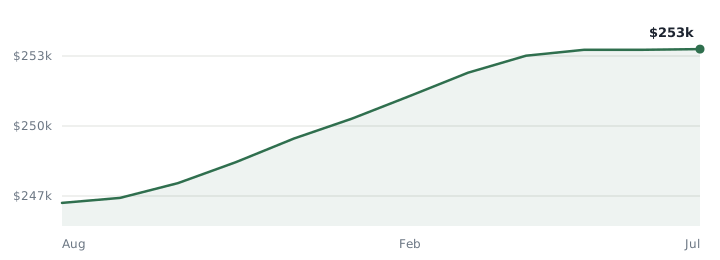
The typical home in Augusta, GA is worth around $253,000, below the national typical value of $369,000. That value is up about 2.8% over the past year. It is a market-wide figure. A house that needs major work sits well below it, and a renovated one sits above.
The Augusta market right now
- Typical home value
- $253,000
- Days to go under contract
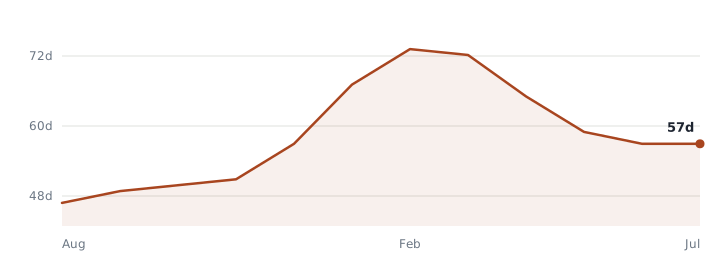
- 59 days
- Listings cutting their price
- 28.0%
- Compared to nationally
- 31% lower
- Homes for sale
- 2,989
- New listings a month
- 749
- Months of supply
- 4.2
- Sales closing below asking
- 55.2%
+2.8% over the past year
+26% vs. a year ago
+1.2% vs. a year ago
National typical value is $369,000
+17% vs. a year ago
-8% vs. a year ago
Broadly balanced
Nationally 50.0%
Augusta, GA housing figures for August 2026, except the share closing below asking, which Zillow publishes a month behind and covers July 2026. Last refreshed September 17, 2026. Source: Zillow Research. Months of supply is calculated here as for-sale inventory divided by the monthly sales count. These are market-wide figures, not a valuation of any individual property.
What the Augusta numbers mean for your sale
Houses here take about 59 days on average to go under contract. That is roughly in line with the national figure of 53 days. Keep in mind that clock stops at contract, not at closing. A buyer with a mortgage then needs another 30 to 60 days to fund. So a normal sale in Augusta realistically takes a few months from listing to money in your account.
About 28.0% of listings in Augusta have cut their asking price, close to the national share of 26.4%. That is a normal amount of repricing. Neither buyers nor sellers have a clear edge right now.
If timing is your main question, see how long it takes to sell a house in Augusta. It goes stage by stage, including what a normal sale adds after the house goes under contract.
If the real question is whether you can afford to keep it, see what it costs to own a home in Augusta. That includes what owners with no mortgage left still pay.
How to think about it here
Augusta sits close to the national average on both speed and price cuts, so neither route is clearly right. It comes down to your house and your situation. If the house is in good shape and you can wait a few months, listing will usually net more. If it needs real work, has people living in it, or you face a date you cannot move, certainty is worth more than the difference.
How the sale runs, from first call to closing, is on how it works. The side-by-side with listing through an agent, including the row where listing wins, is on cash offer vs realtor.
An Augusta closing runs through a Georgia attorney
In 2003, the Supreme Court of Georgia ruled that only a licensed Georgia attorney may prepare a deed or oversee its signing. It is the unauthorized practice of law for anyone else to close a real estate sale. So whoever buys your Augusta house, including us, a Georgia attorney handles the closing itself.
Georgia's real estate transfer tax is $1 for the first $1,000 of the sale price and 10 cents for each additional $100. That works out to $1 per $1,000. The Georgia Department of Revenue says the seller owes it, although sales contracts often shift it to the buyer.
On a $150,000 sale the tax is $150. It has to be paid before the deed can be recorded with the Clerk of Superior Court.
The Department of Revenue also requires a PT-61 real estate transfer tax declaration. It is filed online through the Georgia Superior Court Clerks' Cooperative Authority. If you are not sure whether your transfer is taxable or exempt, ask the Clerk of Superior Court in the county. For Augusta, that is the Richmond County clerk.
Sources: Supreme Court of Georgia (via Justia): In re UPL Advisory Opinion 2003-2; Georgia Department of Revenue: Real Estate Transfer Tax.
Where Augusta records deeds and sets its millage
Deeds for Augusta property are recorded by the Clerk of Superior, State and Juvenile Court at 735 James Brown Boulevard, Suite 1500. The clerk's website links to Georgia's statewide deed index.
Property tax bills come from the Richmond County Tax Commissioner. This elected officer handles homestead exemption applications, the digest, billing and collections.
Augusta's 2025 tax digest notice shows a countywide gross rate of 11.872 mills for maintenance and operations. A 5.595 mill local option sales tax rollback brings it down to a net rate of 6.277 mills.
That net rate is the lowest in the five-year history the city published, which started at 9.045 mills in 2020. It is only one piece of a tax bill, so the bill from the Tax Commissioner is the number that matters at closing.
Sources: Augusta, GA: Clerk of Superior, State and Juvenile Court; Richmond County Tax Commissioner; Augusta, GA: 2025 Tax Digest and 5 Year History of Levy.
Flooding and the Augusta buyout program
Augusta runs a voluntary Flood Buyout Program through its Planning and Development Department. The city reports it has bought 77 properties since 2000. It used state and federal grants, local match money and SPLOST sales tax dollars. Homes on those lots are torn down, and the land stays open space so it can hold floodwater.
Residents contact the city to be considered. Preference goes to occupied homes in the floodplain that flood often. If your house has flooded again and again, ask about that program alongside any sale.
To check a flood zone, use FEMA's Map Service Center or Augusta's GIS map, or call the floodplain manager at (706) 821-1796. Augusta is a Class 7 community in FEMA's Community Rating System. That gives local policyholders a 15 percent discount on flood insurance premiums.
Sources: Augusta, GA: Floodplain Management.
Historic district reviews in Augusta
A house in one of Augusta's designated historic districts needs a Certificate of Appropriateness for any material change to its exterior. That includes rehabilitation, additions, demolition and relocation.
The Historic Preservation Commission reviews applications at its regular meetings. A sign goes up on the property at least 15 days beforehand. Staff can approve some minor projects.
The commission also uses design guideline manuals written just for the Summerville and Bethlehem districts. Buyers planning work there should expect that review.
Local facts checked September 2026. Rates and rules change; a real estate attorney or the office named above can confirm them for your property.
Markets near Augusta
We buy across this whole region, including the towns between these metros.
Selling a house in Augusta
- Do I need an attorney to sell my house in Augusta?
- Yes. In 2003, the Supreme Court of Georgia ruled that only a licensed Georgia attorney may prepare a deed, oversee its signing, or close a real estate sale. That applies to every Augusta sale, whether the buyer is a family or a cash buyer.
- How much is the transfer tax on an Augusta home sale?
- Georgia charges $1 for the first $1,000 and 10 cents for each additional $100. That is $1 per $1,000 of the price. The Georgia Department of Revenue says the seller owes it, though contracts often have the buyer pay it.
- Will Augusta buy a house that keeps flooding?
- Augusta's Flood Buyout Program is voluntary. It has bought 77 properties since 2000, with preference for occupied homes in the floodplain that flood often. The program relies on grant and local funding. Call the city's floodplain manager at (706) 821-1796 to ask whether your property can be considered.
Tell us what you need for your Augusta house
Two minutes to ask, no obligation, and no fee whatever you decide. If we are not the right answer, we will say so.

Sabrina usually picks up. (615) 576-8827