What it costs to own a home in San Jose, CA
The median homeowner with a mortgage in San Jose, CA spends about $4,001 a month to keep the house, of which property taxes are about $9,554 a year. That is the full cost of owning, not just the loan payment. It includes the mortgage, property taxes, insurance, utilities and any HOA fees. It decides whether staying is affordable, and it is the number people underestimate when they buy.
US Census Bureau, American Community Survey 5-year estimates averaging 2019 to 2023. They show the usual cost of owning here, not this month.
- Monthly, with a mortgage
- $4,001
- Monthly, mortgage paid off
- $1,072
- Property taxes
- $9,554/yr
- Spending over 30% of income
- 32.8%
All in: loan, taxes, insurance, utilities
What ownership costs with no loan at all
Median for the metro
Of 253,874 mortgaged households
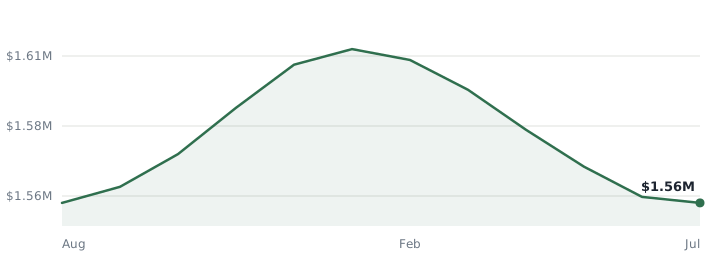
How many people here are stretched
About 32.8% of San Jose homeowners with a mortgage spend more than 30% of their household income on housing. HUD and the Census Bureau call a household cost burdened once housing takes more than 30% of income. That is where housing starts crowding out everything else. Roughly 253,874 households here carry a mortgage. That is a high share by national standards, and it is the math behind a lot of the calls we get. When a third of mortgaged owners are already stretched, it takes very little to tip a household over. An insurance renewal, a tax reassessment, a roof or one lost income can do it.
Across the 100 largest metros we track, that is the 19th highest share of stretched homeowners. Property tax makes up about 20% of the yearly cost of holding a house here. Every nearby market we track is cheaper to hold, including San Francisco at $3,839 and Stockton at $2,376.
On the other half of the picture, houses in San Jose take about 37 days on average to go under contract. So even where a normal sale is the right answer, it is not a quick fix for a monthly cost problem.
The house with no mortgage on it
Owners in San Jose who have paid off the mortgage still spend about $1,072 a month, compared with $4,001 for owners still paying one. That money goes to taxes, insurance, utilities and upkeep, and it does not stop when the loan does. So an inherited house with no mortgage can still cost more than the family can afford to keep. "There is no mortgage" is not the same as "there is no hurry".
How Prop 13 shapes a San Jose tax bill
If you have owned your San Jose home for years, your tax bill likely rests on an old number. The Santa Clara County Assessor explains how Proposition 13 works. Your base year value is the market value when you got the house. It can rise by no more than 2 percent a year.
The general tax is capped at 1 percent of that value. Voter-approved bonds and special assessments are added on top.
The bonds are why San Jose addresses differ. In the county's 2025-26 rate book, tax rate area 017-001 in San Jose totals 1.2750 percent. That includes the 1 percent levy, a 0.0388 percent county retirement levy, and county, school and college bonds.
Across the San Jose tax rate areas in the book, totals run from about 1.14 to 1.31 percent.
Sometimes the market drops below your factored base year value on January 1. Then Proposition 8 requires the Assessor to lower your assessment for a while. As the market recovers, the value can rise faster than 2 percent until it reaches the factored base year value again.
Sources: Santa Clara County Assessor: Assessment information booklet 2026; County of Santa Clara: Compilation of tax rates and information, 2025-2026.
Flat charges that sit beside the rate in San Jose
Not every line on the bill depends on value. The Assessor lists direct charges such as:
- sewer service charges
- school parcel taxes
- benefit assessments
- Mello-Roos and improvement bonds, where they apply.
Those do not shrink when your assessed value is low.
One countywide example is Valley Water's Safe, Clean Water special parcel tax. Voters renewed it in November 2020. Valley Water offers an exemption. It is for owners who:
- live in the home
- were born before June 30, 1962
- had 2025 household income around $75,112 or less.
School parcel taxes change with elections. A $72 San Jose Unified School District parcel tax approved in 2016 was set to expire June 30, 2025.
San Jose Inside reported in May 2025 that its renewal drew about 60.5 percent. That fell short of the two-thirds needed.
Sources: Santa Clara County Assessor: Assessment information booklet 2026; Valley Water: Low-income senior parcel tax exemption; San Jose Inside: Voters reject parcel tax renewal for San Jose Unified School District.
What moving or passing the house on does to the tax
A sale resets the base year value for the buyer. The county then sends a supplemental bill for the difference, prorated for the rest of the fiscal year. The Assessor notes this bill is usually not split in escrow or paid from a lender impound account.
Proposition 19 has been in effect since 2021. It lets an owner 55 or older, or severely disabled, carry a base year value to a replacement home anywhere in California. You can do this up to three times, if you buy the new home within two years of the sale.
It also narrowed the parent-child exclusion to the family home. A child must live there and file for the homeowners' or disabled veterans' exemption within one year. The exclusion is limited to taxable value plus $1 million as adjusted.
The Board of Equalization explains the details. A real estate attorney can confirm how they apply to you.
Sources: Santa Clara County Assessor: Supplemental assessments; California State Board of Equalization: Proposition 19.
Transfer taxes on a San Jose sale
San Jose is one of the cities that add their own tax on top of the county's. The Santa Clara County Clerk-Recorder lists two rates:
- county documentary transfer tax: $0.55 per $500 of value
- San Jose city conveyance tax: $1.65 per $500.
On a $1,000,000 sale, that works out to $1,100 for the county and $3,300 for the city.
Measure E adds a real property transfer tax on higher-priced sales. Since July 1, 2025, the Clerk-Recorder collects it on San Jose sales above $2,300,000. It applies to the full price, at these rates:
- 0.75 percent up to $5 million
- 1 percent up to $10 million
- 1.5 percent above that.
Sources: Santa Clara County Clerk-Recorder: Recording document fees; Santa Clara County Clerk-Recorder: Measure E; City of San Jose: Measure E real property transfer tax.
Local facts checked September 2026. Rates and rules change; a real estate attorney or the office named above can confirm them for your property.
If keeping it no longer works
For what a normal sale would involve here, see how long it takes to sell a house in San Jose. For the market as it stands this month, see our San Jose page.
Common questions
- How much does it cost to own a home in San Jose?
- About $4,001 a month for the median owner with a mortgage. That covers the loan, property taxes, insurance, utilities and any HOA fees. Owners who have paid off the mortgage still spend about $1,072 a month on everything else. Census figures averaging 2019 to 2023.
- How much are property taxes in San Jose?
- The median household pays about $9,554 a year. That is a median for the whole metro, so a pricier house pays more. A reassessment after a sale or an improvement can also move it sharply. Your own bill is the one that matters, and it is public record.
- What is the property tax rate in San Jose?
- Santa Clara County's 2025-26 rate book shows San Jose tax rate areas totaling roughly 1.14 to 1.31 percent of assessed value. That includes the 1 percent general levy. Flat parcel taxes and direct charges are added separately.
- Does San Jose's Measure E apply to my home sale?
- Only if the price is above $2,300,000, the threshold in effect since July 1, 2025. The rate is 0.75, 1 or 1.5 percent of the full price, depending on the price band.
- Can I keep my low San Jose tax base if I move?
- You may, if you qualify. Under Proposition 19, owners 55 or older or severely disabled can move their base year value to a replacement home anywhere in California. They can do it up to three times, if they buy within two years of selling.
Source: U.S. Census Bureau, American Community Survey 5-year estimates, 2019-2023. Tables B25088, B25091 and B25103. Figures are metro-wide medians and describe no individual property.
Tell us what you need for your San Jose house
You do not need a number ready, or photos, or a plan. Want to know your real options, even the ones that do not involve us? Call and ask.

Sabrina usually picks up. (615) 576-8827