How long does it take to sell a house in Detroit, MI?
A house listed in Detroit, MI takes about 32 days on average to go under contract. That is faster than the national average of 53 days. Closing then usually adds another 30 to 45 days. That is how long a buyer with a mortgage usually needs to fund, though it varies by lender and by how complex the sale is. So a normal sale here realistically runs about 62 to 77 days, from the day the sign goes up to the day the money arrives. That is before any time spent getting the house ready to list.
That makes Detroit the 27th fastest of the 100 largest US metro markets. Nearby markets vary too: Toledo at 26 days and Cleveland at 26 days move quicker, while Pittsburgh at 37 days takes longer. For any one house, its own market matters more than the region.
Market figures below cover August 2026 and were last refreshed on September 17, 2026.
- Listing to under contract
- 32 days
- Under contract to closing
- 30 to 45 days
- Realistic total
- 62 to 77 days
- Selling to us instead
- 1 to 3 weeks
Measured, market-wide average
Estimate, set by the buyer's lender
Before any time spent preparing to list
Paced by the title search, not financing
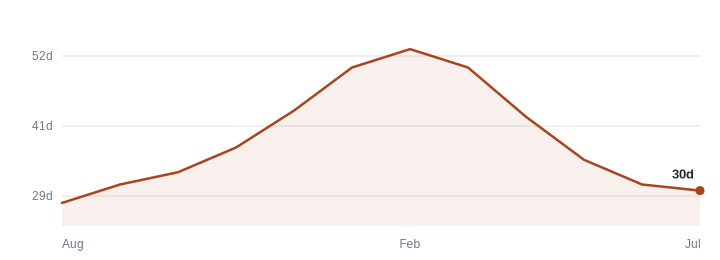
What is driving the timeline in Detroit specifically
Detroit has only about 2.8 months of supply. Buyers have few choices, which is the main reason a sound house here does not sit long.
About 27.8% of listings here have already cut their asking price. Each one started at a price the market would not pay, and finding that out added weeks. Pricing right on day one is the biggest thing a seller controls.
About 40.4% of completed sales closed below the asking price, so plan for the haggling as well as the wait. The listed price and the final price are different numbers.
If a sale falls apart over financing or inspection, the house goes back on the market and the clock starts over. That is why an average is a poor guide to the worst case, in Detroit as anywhere else.
Months of supply is for-sale inventory divided by the monthly sales count, both from Zillow Research for August 2026. The typical home in Detroit is worth about $267,000.
Unpaid taxes can stop a Detroit deed from recording
The step most likely to hold up a Detroit closing is the tax certificate. Before the Wayne County Register of Deeds records certain papers, the Wayne County Treasurer must certify the property taxes are paid. That covers:
- warranty deeds, and deeds with a covenant of warranty
- land contracts and assignments of land contracts.
The Register also lists a missing tax certificate as one of its common reasons for turning a document away. Check your tax status early. That leaves time to settle any balance before closing day.
If you are behind, the Wayne County Treasurer explains how the clock runs. It uses 2022 taxes as its example.
On March 1, 2023, the unpaid 2022 taxes became delinquent. They moved to the county treasurer with a 4 percent fee and 1 percent monthly interest.
On March 1, 2024, the property was forfeited. A $175 fee and $30 in recording fees were added. Interest rose to 1.5 percent a month, counted back to March 2023.
In March 2025, a circuit court ordered the foreclosure. Owners could still pay and keep the house until March 31, 2025. On April 1, 2025, title passed to the county treasurer.
The Treasurer's tax information line is 313-224-5990.
A sale that closes before that final March 31 deadline can pay off what you owe. After it, you no longer own the house to sell.
Sources: Wayne County Register of Deeds: Document Recording; Wayne County Treasurer: Forfeiture/Foreclosure Timeline.
Transfer tax is paid when the Detroit deed is recorded
A Detroit deed carries two transfer taxes, one for the state and one for Wayne County. The seller owes the state tax (MCL 207.523). It is $3.75 per $500 of value (MCL 207.525).
The Wayne County Register of Deeds adds the county tax of $0.55 per $500. Together that is $8.60 per $1,000 of the price. It must be paid when the deed is recorded, unless the deed lists an exemption.
By our own math, a $150,000 sale owes $1,290. That is $1,125 in state tax and $165 in county tax.
If the house was your main home, check one exemption. You may not owe the state part of the tax (MCL 207.526(u)).
It applies when you claimed the principal residence exemption. The home's state equalized value must be no higher than when you got it. And the price must be a fair, arm's length market price.
If you paid the tax and later think you qualified, the law lets you ask the Michigan Department of Treasury for a refund.
Under a fee schedule that took effect January 1, 2026, the Register charges $26 to record a deed. Where it applies, there is also a $4 state survey and remonumentation fee.
Sources: Michigan Legislature: MCL 207.523, Person liable for state transfer tax; Michigan Legislature: MCL 207.525, State transfer tax rate; Michigan Legislature: MCL 207.526, Exemptions from state transfer tax; Wayne County Register of Deeds: Document Recording.
When Michigan's seller disclosure has to be delivered
If Michigan's Seller Disclosure Act covers your sale, you must give the buyer the written disclosure form before you both sign a binding purchase agreement (MCL 565.954).
If it arrives after signing, the buyer can cancel by written notice. They have 72 hours if they got it in person, or 120 hours if it came by registered mail. That right to back out ends once the deed is delivered.
In practice, finishing the form before you sign means the buyer has no window to walk away. The act has its own list of which sales are covered and which are exempt. A real estate lawyer can confirm whether yours is covered.
Sources: Michigan Legislature: MCL 565.954, Seller disclosure delivery and termination.
Local facts checked September 2026. Rates and rules change; a real estate attorney or the office named above can confirm them for your property.
If the timeline is the problem
Selling to a cash buyer skips both the listing period and the lender. That cuts the 62 to 77 days to about one to three weeks, set by the title search rather than a loan. The trade is a lower price for a date you can count on. Whether that is worth it depends on what holding costs are doing to you meanwhile. It also depends on whether a Detroit buyer would have to take on work to buy your house.
Read the full comparison against listing with an agent, which keeps its losing row.
Common questions
- How long does it take to sell a house in Detroit?
- About 32 days on average to go under contract. Then it takes roughly 30 to 45 more days to close if the buyer has a mortgage. That puts a typical sale at about 62 to 77 days from listing to closing. That does not count time spent getting the house ready to list.
- Can I sell my Detroit house if I owe back property taxes?
- Yes, up until the redemption deadline. But the Register of Deeds records warranty deeds only after the Wayne County Treasurer certifies the taxes are paid. In the Treasurer's example, owners had until March 31 of the third year to pay before title passed to the county.
- How much is the transfer tax on a Detroit home sale?
- Wayne County collects $8.60 per $1,000 of the price when the deed is recorded. That is $3.75 per $500 for the state and $0.55 per $500 for the county. By our math, that comes to $1,290 on a $150,000 sale.
- What happens if the Michigan seller disclosure is late?
- If the buyer gets the form after signing the purchase agreement, they can cancel (MCL 565.954). They have 72 hours if it was handed over in person, or 120 hours if sent by registered mail. The right ends when the deed is delivered.
Selling timelines in nearby markets
- Buffalo, NY about 23 days to contract
- Indianapolis, IN about 37 days to contract
- Louisville, KY about 37 days to contract
- Scranton, PA about 37 days to contract
- Allentown, PA about 23 days to contract
- Philadelphia, PA about 31 days to contract
Tell us what you need for your Detroit house
You do not need a number ready, or photos, or a plan. Want to know your real options, even the ones that do not involve us? Call and ask.

Sabrina usually picks up. (615) 576-8827